Urban nitrogen policy should follow pathways, not the calendar
Seasonal fertilizer bans are easy to write and easy to enforce. A new Viewpoint argues they are an imperfect proxy for how nitrogen actually leaves a neighborhood.
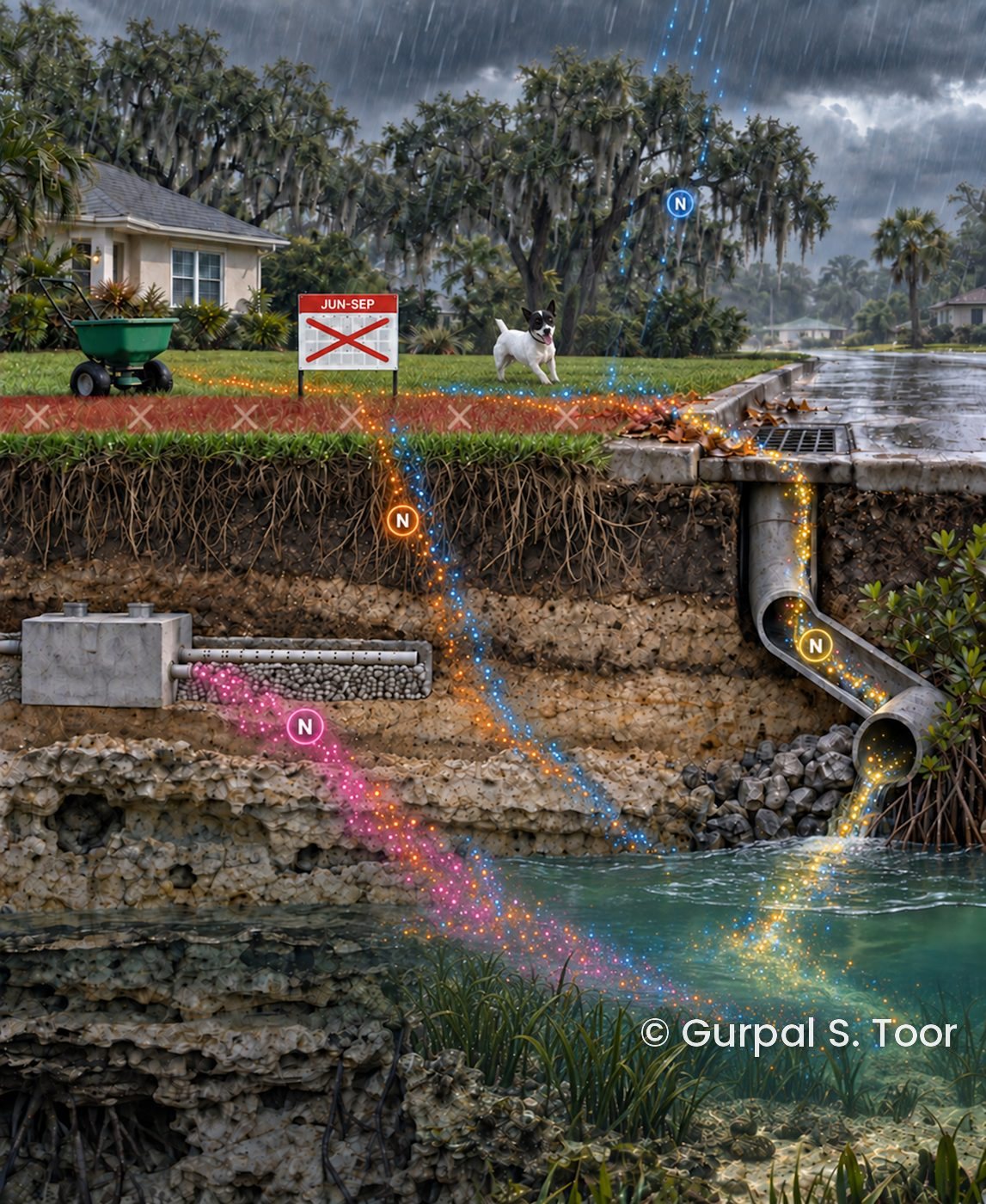
Many Florida communities restrict lawn fertilizer during the summer rainy season. In this Viewpoint I argue that a calendar rule like that is an imperfect proxy for nitrogen export, and that urban nitrogen policy should target what actually controls it: the sources of nitrogen, the chemical forms it takes, the pools where it is stored, and the hydrologic pathways that carry it to water.
The argument draws on a decade of urban stormwater research in the Tampa Bay region with former students and postdocs Yun-Ya Yang, Mary Lusk, and Jariani Jani. That work used nitrate isotopes to trace where stormwater nitrate came from, and characterized the organic nitrogen that nitrate measurements alone miss.